
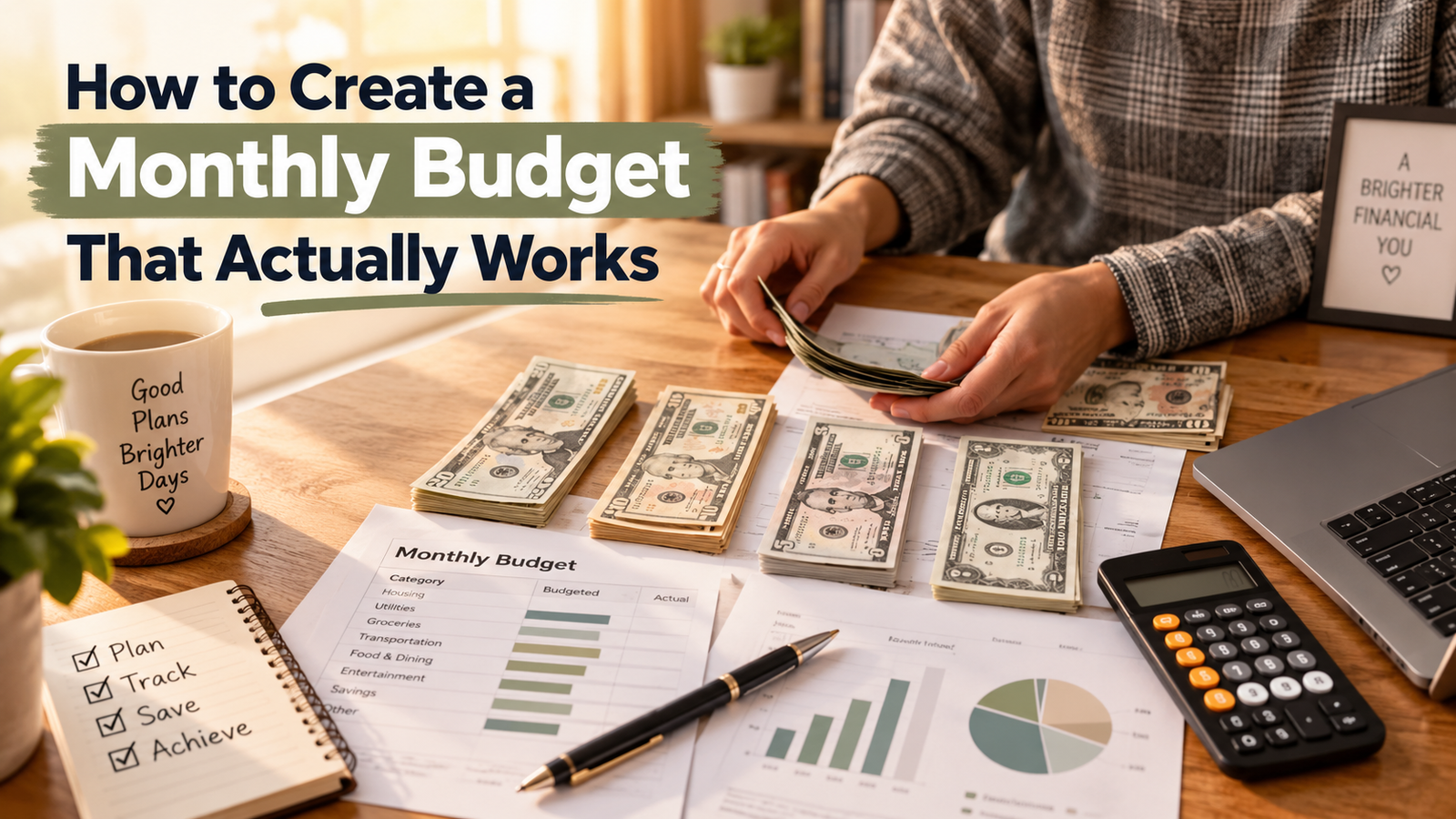
Creating a monthly budget sounds simple: add up your income, list your expenses, and make sure the numbers work. In reality, many people create a budget for a few days or weeks and then stop following it.
The problem usually isn’t the idea of budgeting. It’s creating a budget that doesn’t match your actual lifestyle.
A useful monthly budget should tell you where your money is going, help you prioritize important expenses, and give you enough flexibility for unexpected costs. It should not feel like a punishment or require you to track every small purchase forever.
In this guide, you’ll learn how to create a monthly budget that is realistic, flexible, and easy to maintain—even if you’ve never budgeted before.
What Is a Monthly Budget?
A monthly budget is a plan for how you will use your income during a specific month. It compares the money you expect to receive with the money you expect to spend and save.
A basic budget looks like this:
Monthly Income − Expenses − Savings = Remaining Money
For example, if you take home $4,000 per month and spend $3,200 on expenses while putting $500 into savings, you have $300 remaining.
The goal isn’t necessarily to spend as little as possible. The goal is to make sure your money is being used intentionally.
A good budget can help you:
- Control unnecessary spending
- Pay bills on time
- Build emergency savings
- Reduce debt
- Prepare for irregular expenses
- Save for larger goals
- Understand your financial habits
- Reduce financial stress
Why Do Most Budgets Fail?
Before creating your budget, it’s important to understand why so many budgeting attempts don’t last.
1. The Budget Is Too Restrictive
If you eliminate every restaurant meal, entertainment expense, or small personal purchase, the plan may become impossible to maintain.
A budget that allows no flexibility often works for a short period and then gets abandoned.
2. Expenses Are Underestimated
People often remember rent, utilities, groceries, and transportation but forget expenses such as subscriptions, gifts, maintenance, annual fees, and occasional medical costs.
These expenses may not occur every month, but they still affect your finances.
3. The Budget Uses Perfect Numbers
Your actual spending will rarely match your budget exactly.
For example, you may plan to spend $400 on groceries but spend $435 one month. That doesn’t mean your entire budget failed.
A realistic budget expects some variation.
4. There Is No Emergency Fund
Unexpected expenses can destroy an otherwise good monthly budget.
A car repair, medical bill, broken appliance, or temporary loss of income can require money that wasn’t planned for.
That’s why savings should be part of your budget rather than something you do only when money is left over.
Step 1: Calculate Your Monthly Income
The first step is knowing how much money you actually have available.
If you receive a regular salary, this is relatively straightforward. Use your take-home income—the amount that reaches your bank account after taxes and other deductions.
For example:
| Income Source | Monthly Amount |
|---|---|
| Salary | $3,500 |
| Freelance income | $400 |
| Other income | $100 |
| Total | $4,000 |
If your income changes every month, budgeting requires a little more caution.
Instead of assuming you’ll have your highest possible income, use a conservative estimate based on your recent earnings.
For example, if your recent monthly income has been:
- $3,200
- $3,700
- $3,400
- $3,900
You might create your regular budget around a lower, realistic amount rather than assuming you’ll always earn $3,900.
This reduces the risk of spending money before you’ve actually earned it.
What About Irregular Income?
Freelancers, contractors, business owners, and commission-based workers may not receive the same amount every month.
One useful approach is to separate your income into two categories:
Essential income: Money you can reasonably expect to receive.
Variable income: Money that may or may not arrive.
Build your basic monthly expenses around essential income. When variable income arrives, you can direct some of it toward savings, debt repayment, or other financial goals.
Step 2: Track Your Spending
You can’t create an effective budget if you don’t know where your money is going.
Review your bank statements, credit card statements, receipts, and payment apps from the previous one to three months.
Look for recurring and non-recurring expenses.
Common categories include:
- Housing
- Utilities
- Groceries
- Transportation
- Insurance
- Debt payments
- Subscriptions
- Healthcare
- Entertainment
- Shopping
- Dining out
- Personal care
- Savings
- Investments
Don’t try to judge your spending while you’re collecting the information.
The first goal is simply to understand your current behavior.
Separate Needs From Wants
Once you’ve listed your expenses, divide them into three groups.
Needs
These are expenses that are generally necessary for your basic financial and personal needs.
Examples include:
- Rent or mortgage
- Basic groceries
- Utilities
- Transportation
- Insurance
- Minimum debt payments
Wants
These are expenses that improve your lifestyle but aren’t usually essential.
Examples include:
- Restaurant meals
- Streaming services
- Entertainment
- Expensive clothing
- Hobbies
- Upgraded electronics
Financial Goals
This category includes money that improves your future financial position.
Examples include:
- Emergency savings
- Retirement contributions
- Extra debt payments
- Investments
- Saving for a home
- Saving for education
This classification doesn’t mean wants are bad. It simply helps you understand your priorities.
Step 3: List Your Fixed Expenses
Fixed expenses are costs that usually remain relatively consistent each month.
For example:
| Fixed Expense | Monthly Cost |
|---|---|
| Rent | $1,200 |
| Car payment | $350 |
| Insurance | $180 |
| Internet | $60 |
| Phone | $50 |
| Minimum debt payments | $160 |
| Total | $2,000 |
These expenses should be accounted for before planning discretionary spending.
If your fixed expenses consume almost all of your income, cutting small purchases may not solve the underlying problem.
You may need to examine larger costs such as housing, transportation, debt, or insurance.
Step 4: Estimate Variable Expenses
Variable expenses change from month to month.
Examples include:
- Groceries
- Electricity
- Fuel
- Dining out
- Entertainment
- Clothing
- Household items
Look at your previous spending to create realistic estimates.
Suppose you spent:
- $380 on groceries in one month
- $420 the next month
- $395 the month after
A $400 monthly grocery budget may be more realistic than setting an arbitrary $250 limit.
Your budget should be based on your actual life—not numbers that simply look good on paper.
Step 5: Pay Yourself First
One of the most important budgeting principles is to treat savings as an expense rather than an afterthought.
Instead of this:
Income → Expenses → Whatever Is Left → Savings
Try this:
Income → Savings → Essential Expenses → Flexible Spending
For example, if your monthly income is $4,000, you might automatically transfer $400 into savings after receiving your income.
You can then build your spending plan around the remaining $3,600.
The appropriate savings amount depends on your income, expenses, debt, financial goals, and circumstances. There is no single percentage that works for everyone.
Step 6: Create an Emergency Fund
An emergency fund is money set aside for unexpected expenses or financial disruptions.
Possible emergencies include:
- Job loss
- Major car repairs
- Unexpected medical expenses
- Home repairs
- Emergency travel
- Essential replacement purchases
If you’re starting from zero, don’t worry about reaching a large target immediately.
Start with a manageable amount.
For example:
$25 per week × 4 weeks = approximately $100 per month
Over time, those contributions can build a meaningful financial cushion.
Once you have a basic emergency reserve, you can gradually work toward a larger amount based on your personal situation and essential monthly expenses.
The important point is consistency.
Step 7: Give Every Dollar a Job
After listing income, expenses, and savings, allocate the remaining money intentionally.
For example:
| Category | Amount |
|---|---|
| Income | $4,000 |
| Housing | $1,200 |
| Utilities | $200 |
| Groceries | $400 |
| Transportation | $350 |
| Insurance | $180 |
| Debt payments | $300 |
| Personal spending | $250 |
| Entertainment | $120 |
| Emergency savings | $400 |
| Other expenses | $300 |
| Remaining | $300 |
The $300 remaining shouldn’t simply disappear into unplanned spending.
You could assign it to:
- Extra debt payments
- Additional savings
- Investments
- A future purchase
- A sinking fund for irregular expenses
The exact allocation depends on your financial priorities.
Step 8: Use Sinking Funds for Irregular Expenses
One of the most overlooked budgeting techniques is the sinking fund.
A sinking fund is money you gradually save for an expense you know will happen eventually.
Examples include:
- Annual insurance premiums
- Holiday spending
- Car maintenance
- Property taxes
- School expenses
- Birthdays
- Home maintenance
- Annual subscriptions
Suppose you expect to spend $600 on car maintenance over the next year.
Instead of trying to find $600 when the expense arrives:
$600 ÷ 12 months = $50 per month
You can set aside $50 each month.
When the expense occurs, the money is already available.
This makes irregular expenses much easier to manage.
Step 9: Choose a Budgeting Method
You don’t need a complicated budgeting system.
Choose a method you can actually maintain.
Zero-Based Budget
With a zero-based budget, you assign your income to specific expenses, savings, debt payments, and goals until there is no unassigned money.
This doesn’t mean your bank account should reach zero. It means every dollar has a planned purpose.
50/30/20 Budget
The 50/30/20 framework generally divides after-tax income into:
- 50% for needs
- 30% for wants
- 20% for savings and debt repayment
It’s a useful starting framework, but it isn’t a law.
Someone living in an expensive city may spend more than 50% on necessities. Someone aggressively paying off debt may allocate much more than 20% toward financial goals.
Use the framework as a guide rather than a rigid rule.
Envelope or Category Budgeting
This method assigns spending limits to categories such as groceries, entertainment, and dining.
Once a category reaches its limit, you either stop spending in that category or intentionally move money from another category.
This can be particularly useful for people who struggle with discretionary spending.
Step 10: Automate Your Budget
Automation can make budgeting much easier.
You can schedule automatic transfers for:
- Emergency savings
- Retirement
- Investment accounts
- Debt payments
- Regular bills
Automation reduces the number of decisions you need to make each month.
If your financial institution allows it, consider scheduling transfers shortly after your normal payday.
However, always make sure your account will have enough money available for scheduled payments to avoid overdrafts or other fees.
Step 11: Review Your Budget Every Week
You don’t need to spend hours managing your budget.
A short weekly review can be enough.
Ask yourself:
- How much have I spent?
- Which categories are getting close to their limits?
- Are all upcoming bills covered?
- Did an unexpected expense appear?
- Am I still on track with my savings goal?
A 10–15 minute review can prevent small problems from becoming major ones.
What to Do When You Overspend
Overspending doesn’t mean you should abandon your budget.
Instead, identify what happened.
For example, suppose you budgeted $300 for dining out but spent $380.
Don’t simply write “$80 over budget” and move on.
Ask:
- Was the budget unrealistic?
- Did an unusual event occur?
- Can another category be reduced?
- Is dining out consistently higher than expected?
If you repeatedly overspend in the same category, the problem may be the budget itself.
A budget should reflect reality while still helping you improve your financial habits.
Common Budgeting Mistakes to Avoid
Ignoring Small Expenses
Small purchases can add up.
A few subscriptions, frequent takeout orders, delivery fees, and impulse purchases may create a meaningful monthly expense.
Forgetting Annual Expenses
A $600 annual expense is effectively $50 per month.
Ignoring it doesn’t make it disappear.
Setting Unrealistic Spending Limits
If you regularly spend $500 on groceries, setting a $200 budget without a realistic plan for changing your shopping habits is unlikely to work.
Treating Savings as Optional
If you save only whatever remains at the end of the month, there may be nothing left.
Make savings part of your plan.
Making the Budget Too Complicated
You don’t need 40 categories.
Start with broad categories and add detail only when necessary.
A Simple Monthly Budget Template
You can use this basic structure:
| Category | Planned | Actual |
|---|---|---|
| Monthly income | $____ | $____ |
| Housing | $____ | $____ |
| Utilities | $____ | $____ |
| Groceries | $____ | $____ |
| Transportation | $____ | $____ |
| Insurance | $____ | $____ |
| Debt payments | $____ | $____ |
| Personal spending | $____ | $____ |
| Entertainment | $____ | $____ |
| Emergency savings | $____ | $____ |
| Investments | $____ | $____ |
| Other | $____ | $____ |
| Remaining | $____ | $____ |
The “planned” column shows what you intend to spend. The “actual” column shows what really happened.
Comparing these two numbers each month can reveal patterns that aren’t obvious when you’re simply checking your bank balance.
How Long Does It Take to Get Good at Budgeting?
Don’t expect your first budget to be perfect.
The first month is often a learning month.
You may discover that:
- Your grocery estimate was too low
- Your subscriptions cost more than expected
- Your transportation costs fluctuate
- You forgot several annual expenses
- Your savings target needs adjustment
Use this information to improve the next month’s budget.
After several months, you’ll have better data and a much clearer picture of your financial habits.
Final Thoughts
A monthly budget works when it is realistic enough to follow and structured enough to keep you accountable.
Start by calculating your actual income, tracking your spending, separating needs from wants, planning for irregular expenses, and setting aside money for savings and financial goals.
Don’t aim for perfection.
The purpose of a budget isn’t to prevent you from enjoying your money. It’s to help you decide where your money should go before it disappears.
A simple budget that you follow every month is far more valuable than a complicated budget that you abandon after two weeks.
Start small, review your progress regularly, and adjust the plan as your income, expenses, and goals change.
Frequently Asked Questions
What is the easiest way to start a monthly budget?
Start with four things: calculate your monthly income, list your essential expenses, review your recent spending, and decide how much you want to save. You can add more categories once you understand your spending patterns.
How much money should I save each month?
There is no universal amount that works for everyone. Your savings target depends on your income, expenses, debt, emergency-fund needs, and financial goals. The most important step is establishing a consistent savings habit.
Is the 50/30/20 rule good for beginners?
Yes, it can be a useful starting framework. However, your actual percentages may need to be different depending on your housing costs, debt, income, and financial goals.
What if my income changes every month?
Use a conservative income estimate based on your recent earnings and prioritize essential expenses. During higher-income months, consider directing additional money toward savings, debt repayment, or other financial goals.
Should I include savings in my monthly budget?
Yes. Savings should be treated as a planned part of your budget rather than money you save only if something is left over.
How often should I review my budget?
A quick weekly review can help you stay on track, while a more detailed review at the end of each month can help you adjust your plan for the following month.
What should I do if I spend more than my budget?
Don’t abandon the budget. Identify why you overspent, adjust another category if appropriate, and determine whether the original spending limit was realistic. Repeated overspending may indicate that the category needs a better estimate or a change in spending habits.