
Creating a budget can feel complicated when you have dozens of expenses to track every month. Rent, groceries, bills, transportation, subscriptions, debt payments, savings, and everyday spending can quickly become difficult to organize.
The 50/30/20 budget rule offers a simpler approach.
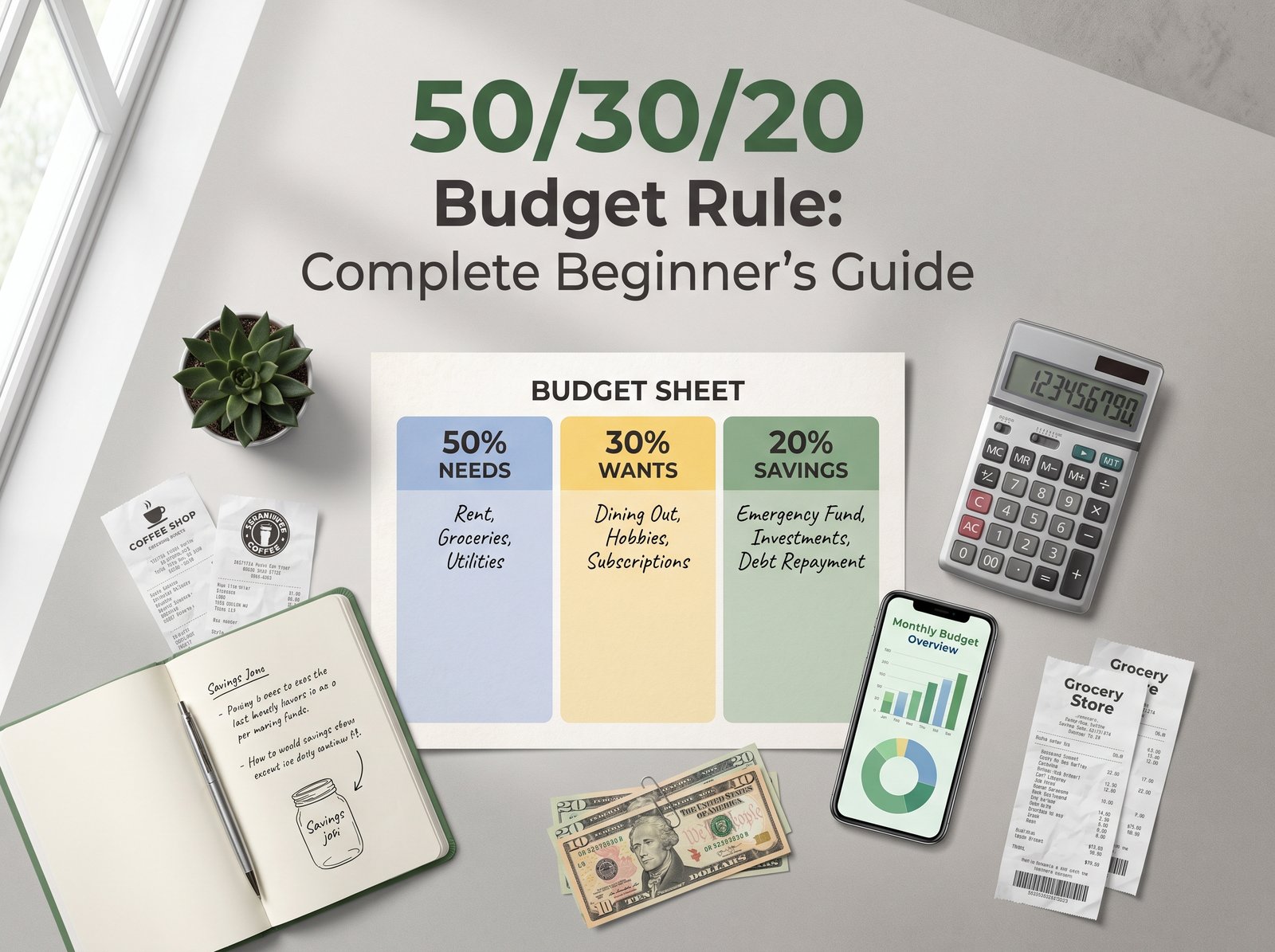
Instead of tracking every purchase in detail, this budgeting method divides your after-tax income into three broad categories:
- 50% for needs
- 30% for wants
- 20% for savings and debt repayment
The idea is to give every part of your income a general purpose while keeping your budget simple enough to maintain.
However, the 50/30/20 rule is not a strict financial law. Your actual percentages may need to change depending on your income, housing costs, debt, family situation, location, and financial goals.
This beginner’s guide explains how the rule works, how to calculate it, what belongs in each category, and how to adapt it when your budget does not fit the standard percentages.
What Is the 50/30/20 Budget Rule?
The 50/30/20 rule is a budgeting framework that divides your monthly take-home pay into three categories.
50% — Needs
About half of your income goes toward essential expenses you need to maintain your basic lifestyle.
Examples include:
- Housing
- Groceries
- Utilities
- Basic transportation
- Insurance
- Essential healthcare
- Minimum debt payments
- Necessary household expenses
30% — Wants
Up to 30% can go toward things that improve your lifestyle but are not essential for basic living.
Examples include:
- Restaurants
- Entertainment
- Streaming services
- Hobbies
- Travel
- Shopping
- Upgraded devices
- Non-essential subscriptions
20% — Savings and Debt Repayment
The final 20% is directed toward improving your financial position.
This may include:
- Emergency savings
- Retirement savings
- Long-term investments
- Extra debt payments
- Other financial goals
The percentages are intended as guidelines, not requirements.
How Does the 50/30/20 Rule Work?
Let’s use a simple example.
Suppose your monthly take-home income is:
$3,000
Using the traditional framework:
50% needs = $1,500
30% wants = $900
20% savings/debt = $600
Your basic monthly structure would look like this:
| Category | Percentage | Amount |
|---|---|---|
| Needs | 50% | $1,500 |
| Wants | 30% | $900 |
| Savings & debt | 20% | $600 |
| Total | 100% | $3,000 |
This gives you a starting framework without requiring you to assign every single purchase to a complicated category.
Step 1: Calculate Your Take-Home Income
The first step is figuring out how much money actually reaches you after taxes and other payroll deductions.
If your monthly take-home income is $3,000, use $3,000 as your budgeting starting point.
If your income varies from month to month, such as freelance or self-employment income, you may need to use a more conservative estimate.
For example, if your recent monthly income has been:
- $2,700
- $3,100
- $2,900
- $3,300
You could create your basic budget using a lower or average figure rather than assuming you will always earn your highest amount.
Step 2: Separate Needs From Wants
This is one of the most important parts of the 50/30/20 method.
Ask yourself:
“Do I need this to maintain my basic life, or do I want it because it improves my lifestyle?”
For example:
Needs
- Rent
- Basic groceries
- Electricity
- Essential transportation
- Insurance
- Minimum debt payments
- Essential medication or healthcare
Wants
- Takeout
- Premium streaming services
- Entertainment
- New clothes that are not necessary
- Expensive hobbies
- Vacations
- Upgraded electronics
The distinction is not always perfect.
For example, a phone may be a need if you depend on it for work, while an expensive flagship upgrade may be a want.
Use common sense rather than trying to force every expense into a rigid definition.
Step 3: Calculate Your 50% Needs Limit
Take your monthly take-home income and multiply it by 50%.
For example:
$4,000 × 50% = $2,000
That gives you a guideline of approximately $2,000 for needs.
Now add your essential expenses.
| Need | Monthly Cost |
|---|---|
| Housing | $1,100 |
| Groceries | $350 |
| Utilities | $150 |
| Transportation | $200 |
| Insurance | $100 |
| Healthcare | $50 |
| Minimum debt payments | $50 |
| Total | $2,000 |
This budget fits the 50% guideline exactly.
But what if your essential expenses are $2,500?
That does not mean you failed.
It means the standard 50% target may not be realistic for your current situation.
Step 4: Calculate Your 30% Wants Budget
Now calculate 30% of your take-home income.
For $4,000:
$4,000 × 30% = $1,200
That is your general wants guideline.
You could divide it into categories such as:
| Want | Monthly Budget |
|---|---|
| Dining out | $250 |
| Entertainment | $150 |
| Subscriptions | $80 |
| Shopping | $250 |
| Hobbies | $150 |
| Travel fund | $200 |
| Miscellaneous | $120 |
| Total | $1,200 |
You do not have to spend the entire 30%.
If you only spend $800 on wants, the extra $400 could potentially go toward savings, debt repayment, or another financial goal.
Step 5: Allocate 20% to Savings and Debt
The final category is designed to improve your financial position.
With a $4,000 monthly income:
$4,000 × 20% = $800
That $800 could be divided between different goals.
For example:
| Financial Goal | Monthly Amount |
|---|---|
| Emergency fund | $300 |
| Retirement | $250 |
| Extra debt payment | $150 |
| Other savings goal | $100 |
| Total | $800 |
The exact allocation depends on your financial priorities.
If you have no emergency fund, building one may be an important early goal.
If you already have sufficient emergency savings but have expensive debt, additional debt repayment may deserve more attention.
What Counts as Savings?
The 20% category is broader than simply putting money into a savings account.
Depending on your situation, it can include:
- Emergency fund contributions
- Retirement contributions
- Long-term savings
- Investment contributions
- Down-payment savings
- Extra debt payments
- Other financial goals
The goal is to use part of your income to strengthen your future financial position rather than spending all of it immediately.
What If You Cannot Follow 50/30/20?
This is where beginners often misunderstand the rule.
If your needs already consume 65% of your income, you cannot simply force them down to 50% overnight.
For example:
Needs: 65%
Wants: 20%
Savings/debt: 15%
This may still be a perfectly useful budget.
Your current percentages reflect your circumstances.
The 50/30/20 rule should be used as a framework, not a test you either pass or fail.
Housing Costs Can Change Everything
Housing is often one of the biggest expenses in a household budget.
If rent or mortgage payments consume a large portion of your income, keeping all needs under 50% may be difficult.
Instead of feeling guilty about not meeting the rule, look at the overall picture.
Ask:
- Can housing costs be reduced?
- Can other fixed expenses be negotiated?
- Can unnecessary wants be reduced?
- Can income increase over time?
- Can savings gradually increase?
The objective is to create a sustainable financial system.
What If You Have a Low Income?
The 50/30/20 rule can be harder to follow when income is low because essential expenses may consume most of your earnings.
You might temporarily have a budget like:
65% needs
15% wants
20% savings
Or:
75% needs
10% wants
15% savings
That is okay.
Start with your actual numbers and improve the budget gradually.
Even if you cannot save 20% right now, building a consistent savings habit can still be valuable.
What If You Have High-Interest Debt?
If you have significant high-interest debt, you may choose to adjust the traditional framework.
For example:
55% needs
15% wants
30% debt repayment and savings
The additional 10% could be directed toward paying down expensive debt.
Once your debt decreases, you can redirect that money toward savings and long-term goals.
Always consider the specific interest rates, minimum payments, and terms of your debts when deciding how aggressively to repay them.
How to Use the Rule With Irregular Income
Freelancers, contractors, business owners, and commission-based workers may not receive the same amount every month.
In this situation, avoid building your lifestyle around your best month.
One approach is to estimate your income conservatively.
For example, if your recent monthly income varies between $2,500 and $4,000, you might create your essential budget around a lower baseline.
When you earn more than expected, you can direct the additional money toward:
- Emergency savings
- Debt repayment
- Long-term goals
- Business expenses
- Planned purchases
This can reduce the risk of increasing your lifestyle every time you have a strong month.
50/30/20 Rule Example for a $5,000 Income
Let’s look at another example.
Monthly take-home income:
$5,000
Traditional allocation:
Needs — $2,500
Possible expenses:
- Housing: $1,400
- Groceries: $450
- Utilities: $200
- Transportation: $200
- Insurance: $150
- Other essentials: $100
Wants — $1,500
Possible spending:
- Dining: $350
- Entertainment: $200
- Shopping: $250
- Hobbies: $200
- Travel fund: $300
- Subscriptions and miscellaneous: $200
Savings/Debt — $1,000
Possible allocation:
- Emergency fund: $400
- Retirement: $300
- Extra debt payment: $200
- Other savings: $100
Again, these numbers are examples. Your actual budget should reflect your circumstances.
Common Mistakes With the 50/30/20 Rule
Mistake 1: Treating It as a Strict Rule
The percentages are guidelines.
Your budget does not need to look exactly like 50/30/20 to be successful.
Mistake 2: Calling Everything a Need
A subscription or expensive lifestyle upgrade does not become a necessity simply because you enjoy it.
Review your spending honestly.
Mistake 3: Spending the Full 30% Because You Can
The 30% category is a maximum guideline, not a requirement.
If you can spend less on wants, you may be able to save or repay debt faster.
Mistake 4: Ignoring Irregular Expenses
Annual insurance, school expenses, car maintenance, holidays, and other irregular costs can destroy an otherwise good monthly budget.
Create sinking funds for expenses you know are coming.
Mistake 5: Forgetting About Debt
Minimum debt payments generally belong among essential obligations, while additional debt repayment can be part of your financial-goals allocation.
50/30/20 vs. Traditional Detailed Budgeting
The 50/30/20 method is relatively simple.
A detailed zero-based budget may assign every dollar a specific job.
Neither method is automatically better.
50/30/20
Best for people who:
- Want simplicity
- Are new to budgeting
- Do not want to track dozens of categories
- Need a quick financial framework
Detailed Budget
Best for people who:
- Have complicated finances
- Need tight spending control
- Are aggressively paying off debt
- Have irregular income
- Want to track specific financial goals
You can also combine both approaches.
Use 50/30/20 for the big picture and detailed categories underneath it.
TechLighta’s 50/30/20 Budget Worksheet
Use this worksheet to create your own monthly plan.
Step 1: Monthly Take-Home Income
Total monthly income: $________
Step 2: 50% Needs
Target: $________
| Need | Budget |
|---|---|
| Housing | $_____ |
| Groceries | $_____ |
| Utilities | $_____ |
| Transportation | $_____ |
| Insurance | $_____ |
| Healthcare | $_____ |
| Minimum debt payments | $_____ |
| Other essentials | $_____ |
| Total Needs | $_____ |
Step 3: 30% Wants
Target: $________
| Want | Budget |
|---|---|
| Dining out | $_____ |
| Entertainment | $_____ |
| Shopping | $_____ |
| Hobbies | $_____ |
| Subscriptions | $_____ |
| Travel | $_____ |
| Other wants | $_____ |
| Total Wants | $_____ |
Step 4: 20% Savings & Debt
Target: $________
| Goal | Monthly Amount |
|---|---|
| Emergency fund | $_____ |
| Retirement | $_____ |
| Investments | $_____ |
| Extra debt payment | $_____ |
| Other savings | $_____ |
| Total | $_____ |
Step 5: Compare Your Actual Numbers
Needs: _____%
Wants: _____%
Savings/Debt: _____%
Now ask:
What is one category I can improve next month?
How to Make the 50/30/20 Rule Work Long-Term
A budget is useful only when you actually use it.
Try these habits:
Review Your Budget Every Month
Income and expenses change. Your budget should change with them.
Automate Savings
Schedule transfers so saving does not depend entirely on willpower.
Track Your Biggest Expenses
You do not necessarily need to track every coffee. Start with the categories that have the biggest impact.
Increase Savings When Income Increases
When you receive a raise or earn more from freelance work, consider directing some of the increase toward financial goals.
Review Subscriptions Regularly
Small recurring expenses can quietly consume a significant portion of your budget over time.
A More Flexible Version of 50/30/20
You can think of the traditional rule as a starting point:
50% → Needs
30% → Wants
20% → Financial goals
But your personal version could look like:
60/20/20
or
55/25/20
or
65/15/20
The important thing is that your budget should help you:
- Cover essential expenses.
- Control discretionary spending.
- Save for emergencies and future goals.
- Manage debt responsibly.
- Spend money on things that matter to you.
Final Thoughts
The 50/30/20 budget rule is popular because it makes budgeting easier to understand.
Instead of creating an extremely complicated spreadsheet, you can start with three simple questions:
How much do I need?
How much do I want?
How much can I save or use to improve my financial position?
The traditional guideline is 50% for needs, 30% for wants, and 20% for savings and debt repayment.
But your real budget may look different.
If your essential expenses are higher than 50%, do not give up. Start with your actual numbers and look for gradual improvements.
Spend intentionally, save consistently, and adjust the percentages as your income and circumstances change.
A good budget is not about making your life miserable. It is about making sure your money supports both your current needs and your future goals.
Frequently Asked Questions
Is the 50/30/20 rule still useful for beginners?
Yes. It can provide a simple starting framework for people who do not know how to organize their income and expenses. It should be adapted to individual circumstances rather than followed rigidly.
Does 50/30/20 include taxes?
The rule is generally applied to take-home or after-tax income rather than gross income.
What if my needs are more than 50%?
That is common, especially when housing or other essential costs are high. Start with your actual numbers and focus on gradually improving your financial situation.
Does debt repayment count as savings?
Minimum debt payments are generally treated as essential obligations. Additional debt repayment can be included in the financial-goals portion of the framework.
What if I cannot save 20%?
Start with what you can realistically afford. Even a small, consistent contribution can help establish the habit of saving.
Can I spend less than 30% on wants?
Absolutely. The 30% is a guideline, not a target you must spend. Spending less on wants can free up money for savings, debt repayment, or other priorities.
Is the 50/30/20 rule good for irregular income?
It can be adapted for irregular income. Consider using a conservative income estimate and directing stronger-than-expected months toward savings, debt repayment, or planned expenses.
What should I do first if I am starting from zero?
Begin by calculating your take-home income and essential expenses. Then create a small emergency-fund goal and build from there. You do not need a perfect budget before taking the first step.