
Unexpected expenses can happen at any time. A car accident, medical emergency, home damage, or the death of a family member can create a major financial burden.
Insurance is designed to help protect you from some of these financial risks.
Instead of paying the entire cost of a covered loss yourself, you pay an insurance company a certain amount—usually called a premium. In return, the insurer agrees to provide financial protection for covered risks according to the terms of your policy.
But insurance can be confusing when you first encounter terms such as premiums, deductibles, coverage limits, exclusions, claims, and policy terms.
This beginner-friendly guide explains what insurance is, how it works, the main types of insurance, and what to consider before buying a policy.
What Is Insurance?
Insurance is a financial arrangement that helps protect individuals and businesses against certain potential losses.
You enter into a contract with an insurance company. You pay the required premium, and the insurer agrees to provide coverage for specific risks described in the policy.
For example, suppose you have auto insurance.
You pay a premium to maintain your policy. If a covered accident happens, the insurer may help pay for eligible repair or medical costs, subject to your deductible, coverage limits, exclusions, and other policy conditions.
The important point is that insurance does not cover everything.
Coverage depends on the exact policy you purchase.
How Does Insurance Work?
The basic concept is relatively simple.
Step 1: You Choose Coverage
First, you select an insurance policy based on the risks you want to protect against.
Examples include:
- Health insurance
- Life insurance
- Auto insurance
- Home insurance
- Renters insurance
- Travel insurance
- Business insurance
- Disability insurance
Different policies protect against different risks.
Step 2: You Pay a Premium
A premium is the amount you pay to maintain your insurance coverage.
Depending on the policy and insurer, premiums may be paid:
- Monthly
- Quarterly
- Semi-annually
- Annually
The amount varies according to factors such as the type of insurance, level of coverage, personal risk factors, location, age, claims history, and insurer pricing rules.
Step 3: A Covered Event Happens
If something happens that is covered by your policy, you may be able to make a claim.
Examples could include:
- A covered vehicle accident
- A covered medical expense
- Damage to an insured property
- The death of an insured person
Whether a claim is paid depends on the policy terms.
Step 4: You File a Claim
You notify the insurance company and provide the required information or documentation.
The insurer reviews the claim to determine whether the event is covered.
Step 5: The Insurer Pays Eligible Costs
If the claim is approved, the insurance company pays according to the policy.
The amount paid may be reduced by your deductible, subject to coverage limits and other conditions.
What Is a Premium?
A premium is the price you pay for insurance coverage.
For example, imagine an auto insurance policy costs $900 per year.
Your annual premium would be $900.
You may pay the amount in monthly installments if the insurer allows it.
Premiums are not necessarily the same for everyone. Insurance companies assess risk differently depending on the type of policy and applicable regulations.
What Is a Deductible?
A deductible is the amount you are responsible for paying before the insurer contributes toward a covered claim, where the policy includes a deductible.
For example, suppose:
- Covered repair cost = $5,000
- Deductible = $500
If the claim is covered and no other policy conditions reduce the payment, you may pay the first $500 and the insurer may cover the remaining eligible amount.
The exact calculation depends on the policy.
Why Do Deductibles Matter?
A policy with a higher deductible may have a lower premium in some situations.
A lower deductible may make you pay less when filing a covered claim but can come with a higher premium.
This creates an important trade-off:
Lower premium → potentially higher out-of-pocket cost when a claim occurs
Higher premium → potentially lower out-of-pocket cost when a claim occurs
Always compare both costs rather than choosing based only on the premium.
What Is a Policy?
An insurance policy is the contract that explains the coverage provided by the insurer.
It generally contains information about:
- What is covered
- What is excluded
- Coverage limits
- Deductibles
- Premiums
- Policy period
- Claim requirements
- Conditions and obligations
- Cancellation or renewal terms
Your policy documents are important because they explain what protection you actually purchased.
Never assume something is covered simply because it sounds like a reasonable insurance claim.
What Is a Coverage Limit?
A coverage limit is the maximum amount an insurer will pay for a particular covered loss or category of coverage, subject to the policy terms.
For example, suppose a policy has a coverage limit of $100,000 for a particular type of claim.
If a covered loss is $120,000, the policy may not pay the entire amount. Depending on the terms, you could be responsible for costs above the applicable limit.
This is why choosing adequate coverage is important.
What Are Exclusions?
Exclusions are situations, events, or types of losses that the insurance policy does not cover.
Examples vary widely depending on the insurance product.
A policy might exclude certain:
- Types of damage
- Medical conditions or treatments
- Activities
- Events
- Property
- Circumstances
- Types of claims
Exclusions are one of the most important sections to read before purchasing insurance.
A policy with a low premium may appear attractive until you discover that an important risk is excluded.
What Is an Insurance Claim?
An insurance claim is a formal request for payment or coverage after a covered event occurs.
For example, imagine your insured car is damaged in an accident.
You may:
- Report the accident
- Submit a claim
- Provide requested documents
- Have the damage inspected or assessed
- Wait for the insurer’s decision
- Receive payment or approved repair services if the claim is covered
The process varies by insurer and type of insurance.
What Is Underwriting?
Underwriting is the process insurers use to evaluate risk before deciding whether and under what terms to provide coverage.
Depending on the type of insurance, the insurer may consider factors such as:
- Age
- Location
- Health information
- Driving history
- Property characteristics
- Previous claims
- Coverage amount
- Type of activity being insured
Not every insurance product uses the same underwriting process.
The goal is generally to assess the likelihood and potential cost of claims.
Why Does Insurance Cost Different Amounts?
Two people can request similar insurance coverage but receive different premiums.
This can happen because insurers may consider different risk factors.
For example, auto insurance pricing may consider:
- Driving history
- Vehicle type
- Location
- Usage
- Previous claims
- Coverage level
Health or life insurance pricing can involve different factors.
The exact rules depend on the insurance product, insurer, and jurisdiction.
Main Types of Insurance
There are many types of insurance, but the following are among the most common.
Health Insurance
Health insurance helps cover eligible healthcare expenses according to the policy.
Depending on the plan, coverage may include certain:
- Doctor visits
- Hospital services
- Prescription medicines
- Diagnostic tests
- Preventive care
- Specialist services
Plans can differ substantially in what they cover and how much the insured person must pay.
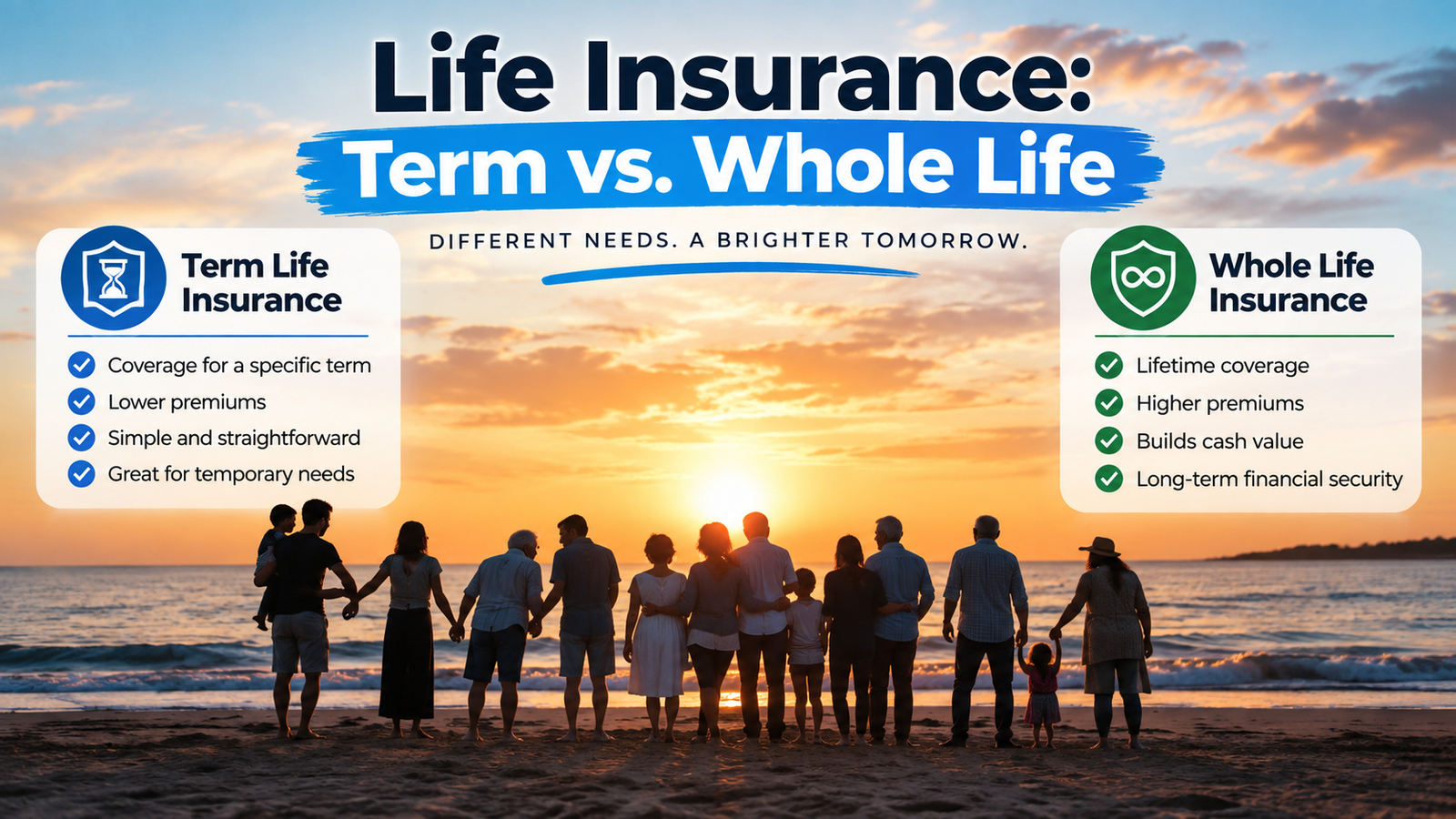
Life Insurance
Life insurance provides a benefit to designated beneficiaries after the insured person’s death, subject to the policy terms.
Two common forms are:
- Term life insurance
- Whole life insurance
These are discussed in more detail in our guide to Term vs. Whole Life Insurance.
Auto Insurance
Auto insurance can provide financial protection against certain risks related to driving and vehicle ownership.
Depending on the policy and local requirements, coverage may include areas such as:
- Liability
- Collision
- Comprehensive or similar physical-damage coverage
- Medical or personal injury coverage
- Uninsured or underinsured motorist protection
Coverage requirements vary by jurisdiction.
Home Insurance
Home insurance can protect against certain covered risks involving a home and its contents.
A policy may include coverage for:
- The building
- Personal belongings
- Liability
- Additional living expenses in certain situations
The exact coverage varies by policy.
Renters Insurance
Renters insurance can help protect a tenant’s personal belongings and may provide liability coverage.
It generally does not insure the physical building itself—that is usually the landlord’s responsibility.
Travel Insurance
Travel insurance can provide protection against certain travel-related risks, depending on the policy.
Potential coverage may include:
- Trip cancellation
- Travel interruption
- Medical emergencies
- Lost baggage
- Travel delays
Not every reason for cancellation or loss is necessarily covered.
Business Insurance
Businesses can purchase different types of insurance to manage risks associated with their operations.
Examples include:
- General liability insurance
- Property insurance
- Professional liability insurance
- Commercial auto insurance
- Workers’ compensation or similar legally required coverage
Requirements vary considerably by business type and location.
Why Is Insurance Important?
Insurance can help reduce the financial impact of unexpected events.
Imagine someone has no insurance and experiences a major covered loss costing $50,000.
They may have to pay the entire amount themselves.
With appropriate insurance, the insurer may cover some or most of the eligible loss according to the policy.
Insurance therefore transfers certain financial risks from the individual to the insurer in exchange for premiums and compliance with the policy terms.
Insurance Is Not an Investment
One common misunderstanding is thinking of all insurance as a way to make money.
The primary purpose of most insurance is risk protection, not investment returns.
You pay for coverage in case a covered event occurs.
If nothing happens, you may not receive your premiums back. That does not necessarily mean the insurance was “wasted.”
You were paying for financial protection during the period the policy was active.
Certain life insurance products may have savings or cash-value features, but those products work differently from basic risk-protection policies.
How Much Insurance Coverage Do You Need?
There is no universal coverage amount that works for everyone.
The appropriate amount depends on factors such as:
- Your financial responsibilities
- Assets
- Income
- Dependents
- Debts
- Potential risks
- Location
- Type of insurance
- Legal requirements
For example, someone with significant financial responsibilities may need different life insurance coverage from someone with few financial obligations.
Similarly, a vehicle owner may choose different auto coverage based on the value of the vehicle, financial situation, legal requirements, and risk tolerance.
How to Choose an Insurance Policy
1. Identify Your Biggest Financial Risks
Start by asking:
What unexpected event could create the biggest financial problem for me?
For one person, it may be a medical emergency.
For another, it may be vehicle damage, property loss, disability, or loss of income.
2. Understand the Coverage
Don’t buy a policy simply because it has a low price.
Read what is actually covered.
3. Check Exclusions
Look for situations that the policy specifically does not cover.
4. Compare Deductibles
A lower deductible is not automatically better if the premium is significantly higher.
5. Check Coverage Limits
Make sure the maximum coverage is appropriate for the risk you are trying to protect against.
6. Compare Multiple Insurers
Insurance pricing can differ between providers.
Compare similar coverage rather than comparing prices for completely different policies.
7. Read the Policy Before Buying
Understand the important conditions before committing.
If something is unclear, ask the insurer or a qualified insurance professional for clarification.
A Simple Insurance Example
Imagine Sarah owns a car worth approximately $20,000.
She has two insurance options.
| Feature | Policy A | Policy B |
|---|---|---|
| Annual premium | $700 | $1,000 |
| Deductible | $1,500 | $500 |
| Coverage limit | Higher | Higher |
| Other terms | Standard | Standard |
Policy A is cheaper each year, but Sarah would potentially have to pay more out of pocket if she makes a covered claim.
Policy B costs more each year but has a lower deductible.
Neither policy is automatically better.
Sarah needs to consider:
- How much she can afford in an emergency
- The likelihood and potential cost of a claim
- The exact coverage
- Exclusions
- Coverage limits
- Her overall budget
This is why insurance decisions should not be based on premium alone.
Common Insurance Mistakes
Choosing the Cheapest Policy
The cheapest policy may not provide adequate protection.
Ignoring Exclusions
A policy can look comprehensive until you discover an important exclusion.
Buying Too Little Coverage
Insufficient coverage can leave you responsible for large expenses.
Choosing a Deductible You Cannot Afford
A deductible should be realistic for your financial situation.
Not Updating Your Policy
Major life changes may affect your insurance needs.
Examples include:
- Buying a home
- Getting married
- Having children
- Purchasing a new vehicle
- Starting a business
- Changing jobs
- Moving to a new location
Forgetting to Review the Policy
Your insurance needs can change over time.
Reviewing coverage periodically can help identify gaps or unnecessary coverage.
TechLighta’s Insurance Policy Checklist
Before purchasing or renewing an insurance policy, use this checklist:
☐ What exactly does the policy cover?
☐ What is excluded?
☐ What is the premium?
☐ How often do I have to pay?
☐ What is the deductible?
☐ What are the coverage limits?
☐ Are there sub-limits for specific claims?
☐ What situations could cause a claim to be denied?
☐ How do I file a claim?
☐ What documents are required for a claim?
☐ Are there cancellation or renewal conditions?
☐ Have I compared similar policies from other insurers?
☐ Can I comfortably afford the deductible?
☐ Does this policy protect against my biggest financial risks?
Insurance Comparison Worksheet
Use this simple worksheet when comparing policies:
| Feature | Policy A | Policy B | Policy C |
|---|---|---|---|
| Insurance Type | |||
| Annual Premium | |||
| Deductible | |||
| Coverage Limit | |||
| Major Coverage | |||
| Major Exclusions | |||
| Claim Process | |||
| Renewal Terms | |||
| Additional Benefits | |||
| Important Notes |
The goal is not simply to choose the cheapest option. Compare policies based on price, protection, exclusions, limits, and your ability to handle out-of-pocket costs.
What Happens If You Never Make a Claim?
This is a common question.
If you never make a claim, you generally do not get all your premiums back simply because you did not use the insurance.
You were paying for protection during the policy period.
Think of it like a financial safety net. You hope you never need to use it, but its value comes from having protection available when a covered event occurs.
Can an Insurance Company Deny a Claim?
Yes, a claim can be denied in certain circumstances.
Possible reasons may include:
- The event is excluded
- The policy had expired
- The loss falls outside the coverage
- Required conditions were not met
- Information provided was inaccurate or incomplete
- The claim exceeds applicable limits
- Required documentation was not provided
If a claim is denied, review the insurer’s explanation and the policy documents. Depending on the jurisdiction, there may be an appeal or complaint process available.
Final Thoughts
Insurance is essentially a tool for managing financial risk.
You pay a premium in exchange for protection against specific risks described in your policy. If a covered event occurs, the insurer may help pay eligible costs according to the policy’s terms, deductibles, exclusions, and coverage limits.
The most important thing is to understand what you are actually buying.
Before choosing insurance, compare premiums, deductibles, coverage limits, exclusions, claim procedures, and overall protection. The cheapest policy is not always the best value, and the most expensive policy is not necessarily the right choice either.
Good insurance planning is about finding a reasonable balance between protection, affordability, and risk.
Frequently Asked Questions
What is insurance in simple words?
Insurance is a financial protection system. You pay a premium to an insurer, and the insurer agrees to help cover certain losses or expenses if specified events occur, according to the policy terms.
How does an insurance company make money?
Insurance companies collect premiums from many policyholders and use those funds to pay eligible claims and cover operating expenses. They may also invest funds according to applicable laws and their business practices.
What is a premium?
A premium is the amount you pay an insurance company for coverage. It may be paid monthly, quarterly, annually, or according to another schedule.
What is a deductible?
A deductible is the amount you may have to pay yourself before an insurer contributes toward a covered claim, depending on the policy.
What is an insurance claim?
An insurance claim is a formal request made to an insurer for payment or coverage following an event that may be covered by the policy.
What are insurance exclusions?
Exclusions are situations, events, losses, or circumstances that the policy specifically does not cover.
Is insurance mandatory?
Some types of insurance are legally required in certain countries or situations, while others are optional. Requirements vary by location and type of insurance.
How often should I review my insurance?
It is useful to review your coverage periodically and whenever there is a major change in your life, finances, assets, family responsibilities, or business activities.
Is the cheapest insurance policy the best?
Not necessarily. A cheaper policy may have lower coverage limits, higher deductibles, or more exclusions. Compare the complete policy rather than looking only at the premium.
What should I do before buying insurance?
Identify your financial risks, determine the protection you need, compare policies, review exclusions and limits, understand the deductible, and read the policy terms before purchasing.
Disclaimer: This article is for general educational purposes and is not insurance, legal, or financial advice. Insurance products, coverage requirements, exclusions, premiums, deductibles, claim procedures, and consumer protections vary by country, insurer, and policy. Always review the specific policy documents and seek qualified professional advice when necessary.