
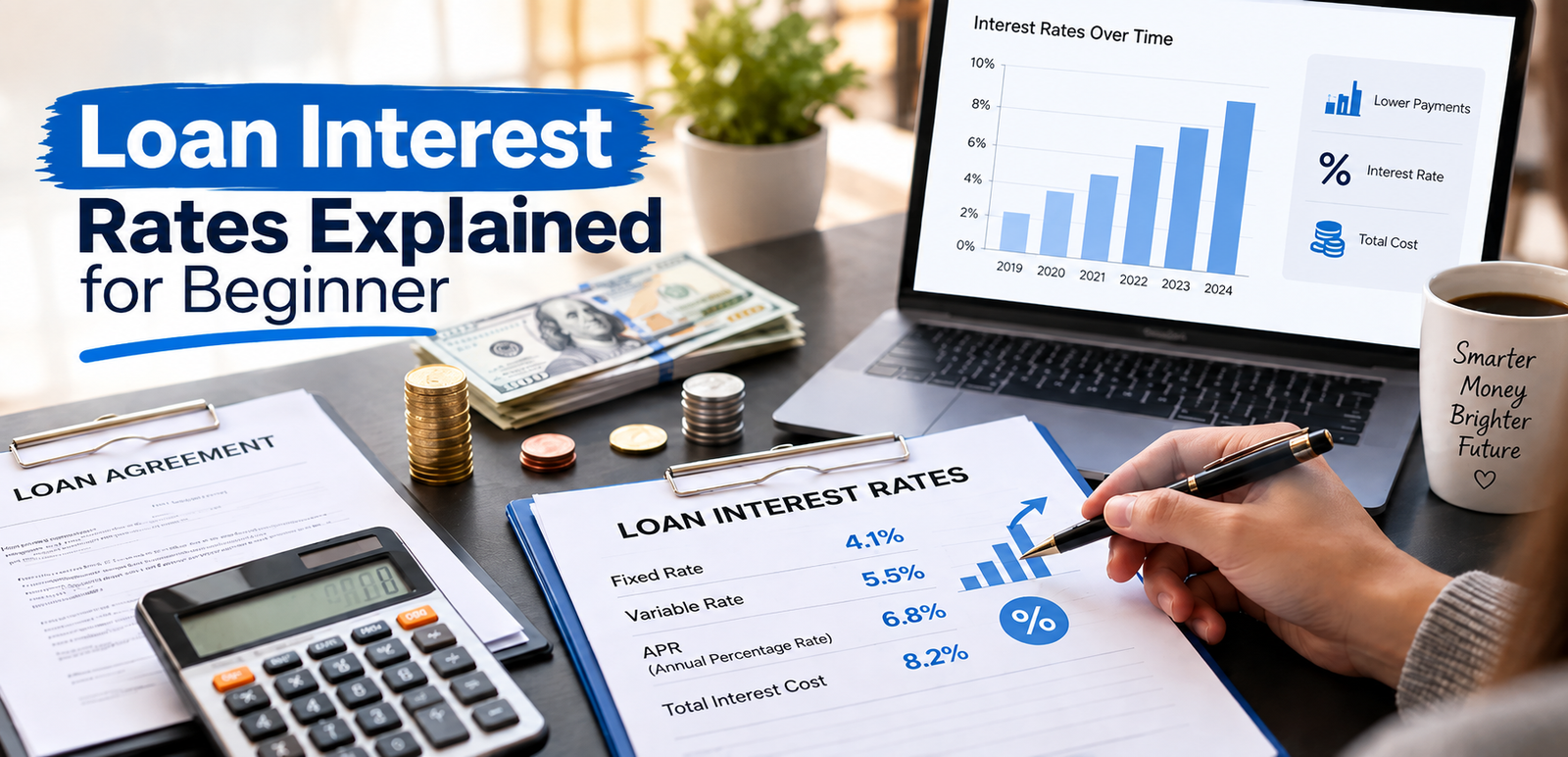
When you borrow money, the lender usually charges you a cost for using that money. This cost is known as interest.
Understanding loan interest rates is one of the most important things to learn before taking out a personal loan, auto loan, mortgage, student loan, or other type of borrowing.
A loan with a lower interest rate can potentially save you a significant amount of money over time. However, the interest rate alone does not tell you the complete cost of a loan. Fees, repayment terms, and other charges can also affect how much you eventually pay.
This beginner-friendly guide explains how loan interest rates work, how they affect monthly payments, what APR means, and how to compare different loan offers.
What Is a Loan Interest Rate?
A loan interest rate is the percentage a lender charges you for borrowing money.
For example, suppose you borrow $10,000 at an annual interest rate of 8%.
The interest rate does not necessarily mean you simply pay 8% of $10,000 every year throughout the loan. For installment loans, interest is generally calculated according to the loan’s repayment structure and outstanding balance.
As you make payments and reduce the principal, the amount on which interest is calculated can also decrease.
The exact calculation depends on the type of loan and the lender’s terms.
Why Do Lenders Charge Interest?
Lending money involves risk.
When a lender gives you money today, it expects to receive that money back over time. During that period, there is a risk that the borrower may fail to repay.
Interest compensates the lender for:
- Providing access to money
- Taking on lending risk
- Administrative and operating costs
- The opportunity cost of lending the money
- Market and funding conditions
The higher the perceived risk, the more expensive borrowing may become, although each lender uses its own pricing and approval criteria.
How Does Interest Affect Your Loan?
The interest rate affects both your regular payment and the total amount you repay.
Consider two hypothetical loans:
| Loan A | Loan B | |
|---|---|---|
| Amount borrowed | $10,000 | $10,000 |
| Interest rate | 7% | 12% |
| Term | 3 years | 3 years |
| Other fees | Same | Same |
If all other factors are identical, Loan B will generally cost more because it has a higher interest rate.
This is why comparing loan rates can make a meaningful difference, especially for larger loans or longer repayment periods.
Simple Interest vs. Loan Interest Calculations
People often use the term “simple interest” when explaining loans, but real installment loans may use more detailed calculations.
A simplified formula for understanding interest is:
Interest = Principal × Interest Rate × Time
For example:
$10,000 × 5% × 1 year = $500
This is useful for learning the basic concept, but it does not necessarily represent the actual interest charged on an amortizing loan.
With many installment loans, interest is calculated periodically based on the remaining principal balance.
That means the actual cost depends on the payment schedule and how quickly the principal is reduced.
What Is a Fixed Interest Rate?
A fixed interest rate generally remains unchanged for the agreed period of the loan.
For example, if your loan has a fixed rate of 9%, the rate does not change simply because market rates later increase.
Advantages of Fixed Rates
- Easier budgeting
- More predictable payments
- Protection against certain future rate increases
- Simpler long-term planning
Possible Disadvantages
- You may not benefit if market rates later fall
- Some fixed-rate loans may have higher starting rates than variable-rate alternatives
Fixed rates can be useful for borrowers who value predictable payments.
What Is a Variable Interest Rate?
A variable or floating interest rate can change according to the terms of the loan.
The rate may be connected to a benchmark or reference rate, plus or minus a lender-specific margin.
For example, a loan might be structured around:
Reference rate + lender margin = loan rate
If the reference rate changes, your loan rate may also change.
Advantages
- You may benefit if rates fall
- Initial rates may sometimes be lower than comparable fixed-rate options
Risks
- Payments may increase
- Future borrowing costs can be harder to predict
- Long-term budgeting may become more difficult
Before choosing a variable-rate loan, understand exactly how and when the rate can change.
Fixed vs. Variable Interest Rates
| Feature | Fixed Rate | Variable Rate |
|---|---|---|
| Rate changes | Usually no | Can change |
| Payment predictability | Higher | Lower |
| Benefit if rates fall | Usually limited | Potentially higher |
| Risk if rates rise | Lower | Higher |
| Budgeting | Easier | More uncertain |
Neither option is automatically better. The right choice depends on the loan, market conditions, your financial situation, and your tolerance for payment changes.
What Is APR?
APR stands for Annual Percentage Rate.
APR is designed to provide a broader picture of borrowing costs than the interest rate alone. Depending on the country and applicable regulations, APR may incorporate certain fees and charges associated with the loan.
This makes APR particularly useful when comparing loan offers.
For example:
| Lender A | Lender B | |
|---|---|---|
| Interest rate | 9% | 9% |
| Fees | Lower | Higher |
| APR | Potentially lower | Potentially higher |
Two loans can have the same advertised interest rate but different overall costs.
When available, compare the APR along with the interest rate, fees, monthly payment, and total repayment amount.
Interest Rate vs. APR: What’s the Difference?
The easiest way to remember the difference is:
Interest rate = cost of borrowing expressed as a rate
APR = broader measure of the annual borrowing cost that may include certain fees
APR is not always calculated in exactly the same way across countries and financial products, so check what is included when comparing offers.
What Determines Your Interest Rate?
Lenders typically consider several factors when deciding what rate to offer.
Credit History
Your borrowing and repayment history can influence the lender’s assessment of risk.
A stronger credit profile may help you qualify for more competitive rates, but approval and pricing criteria vary between lenders.
Income
Lenders may consider whether your income appears sufficient to support the proposed payments.
Existing Debt
If you already have substantial debt, a lender may view additional borrowing as higher risk.
Loan Amount
The amount you want to borrow can affect the terms available to you.
Loan Term
The repayment period can influence pricing and total interest costs.
Collateral
Secured loans are backed by assets. Because the lender has collateral to rely on if the borrower defaults, secured borrowing may have different pricing from unsecured borrowing.
Market Conditions
Interest rates in the wider economy can influence the rates lenders offer.
Why Do People With Similar Profiles Get Different Rates?
Two borrowers can apply for the same loan and receive different offers.
This can happen because lenders may use different:
- Credit assessment models
- Income requirements
- Risk policies
- Fees
- Loan terms
- Funding costs
- Pricing strategies
That’s why comparing multiple offers can be worthwhile.
How Loan Term Affects Interest
The loan term is the amount of time you have to repay the money.
A shorter term usually means:
- Higher monthly payments
- Less time for interest to accumulate
- Potentially lower total interest
A longer term usually means:
- Lower monthly payments
- More time to repay
- Potentially higher total interest
Example
Imagine you borrow $20,000.
You could choose a shorter repayment period with a higher monthly payment or a longer repayment period with a lower monthly payment.
The longer loan may appear more affordable each month, but the total amount paid over the entire loan can be higher.
This is why you should compare both:
Monthly payment + total repayment cost
rather than focusing on the monthly payment alone.
How Amortization Works
Many installment loans are amortizing loans.
With an amortizing loan, scheduled payments gradually reduce the principal balance over time.
Each payment generally includes:
- Interest
- Principal
At the beginning of the loan, a larger portion of the payment may go toward interest because the outstanding balance is higher.
As the principal decreases, the interest portion can decrease as well, while more of the payment goes toward principal.
The exact payment structure depends on the loan agreement.
What Is the Total Cost of a Loan?
The total cost is more than just the amount borrowed.
A useful way to think about it is:
Total cost = Principal + Interest + Applicable fees
For example:
- Amount borrowed: $10,000
- Total interest: $1,200
- Fees: $200
Total repayment cost:
$10,000 + $1,200 + $200 = $11,400
This is a simplified example. Actual loan calculations depend on the interest method, repayment schedule, fees, and lender terms.
Why a Low Monthly Payment Can Be Misleading
Suppose you compare two loans.
Loan A
- Higher monthly payment
- Shorter term
- Lower total interest
Loan B
- Lower monthly payment
- Longer term
- Higher total interest
Loan B may feel easier to manage each month, but it could cost significantly more overall.
Always ask:
“How much will I pay in total by the time this loan is completely repaid?”
That question can reveal the real difference between offers.
How to Get a Better Loan Interest Rate
There is no guaranteed method for getting the lowest rate, but several steps may improve your chances of receiving competitive offers.
1. Check Your Credit Profile
Review your credit history for errors or unexpected issues.
If you find incorrect information, follow the relevant process for disputing it.
2. Improve Your Payment History
Paying existing debts on time can help maintain a healthier credit profile.
3. Reduce Existing Debt
Lower existing debt can improve your overall financial position and may make you a stronger applicant.
4. Compare Multiple Lenders
Don’t assume your first offer is the best one.
Compare:
- Interest rate
- APR
- Fees
- Loan term
- Monthly payment
- Total repayment
5. Borrow Only What You Need
A smaller loan can reduce your overall borrowing cost.
6. Consider Your Loan Term Carefully
Don’t automatically choose the longest repayment period simply because the monthly payment is lower.
7. Consider Secured Options Carefully
A secured loan may have different pricing because it is backed by collateral.
However, putting an asset at risk is an important trade-off. Understand the consequences of default before choosing this option.
Do Interest Rates Change Over Time?
It depends on the type of loan.
With a fixed-rate loan, the interest rate generally remains unchanged according to the agreement.
With a variable-rate loan, the rate can change.
Economic conditions can also affect the rates available when you apply for a new loan.
For this reason, a loan offer available today may not be identical to one available several months later.
What Happens When Interest Rates Rise?
If you already have a fixed-rate loan, a general increase in market rates typically does not change the fixed rate stated in your agreement.
However, borrowers with variable-rate loans may see their interest rate and payment increase, depending on the loan terms.
Higher market rates can also make new borrowing more expensive.
Can You Negotiate a Loan Interest Rate?
Sometimes there may be room to negotiate, but it depends heavily on the lender and product.
Even when the interest rate itself cannot be negotiated, you may be able to compare competing offers and choose a lender with better overall terms.
You can also ask about:
- Fees
- Loan term
- Early repayment rules
- Available discounts
- Automatic payment discounts, where offered
Never assume a discount is available—confirm the terms with the lender.
What NOT to Do When Choosing a Loan
Avoid these common mistakes:
Don’t Choose Only by Interest Rate
A lower advertised rate does not automatically mean a cheaper loan if fees or other terms are significantly different.
Don’t Ignore the Loan Term
The repayment period can have a major effect on total interest.
Don’t Borrow More Just Because You Qualify
The lender’s maximum approval amount may be higher than what your budget can comfortably handle.
Don’t Hide Financial Information
Providing false income or debt information can create serious problems and may result in rejection or other consequences.
Don’t Take a High-Cost Loan Without Understanding It
Some short-term or high-cost loans can become expensive very quickly.
Don’t Ignore the Agreement
Read the complete terms before accepting a loan.
TechLighta’s Loan Interest Rate Comparison Worksheet
Before choosing a loan, use this simple comparison table.
| Loan Detail | Lender A | Lender B | Lender C |
|---|---|---|---|
| Loan Amount | |||
| Interest Rate | |||
| APR | |||
| Fixed or Variable | |||
| Loan Term | |||
| Monthly Payment | |||
| Processing/Origination Fee | |||
| Other Fees | |||
| Total Repayment | |||
| Early Repayment Fee | |||
| Late Payment Fee |
Quick Questions
☐ Do I understand the interest rate?
☐ Do I know whether the rate is fixed or variable?
☐ Have I checked the APR where applicable?
☐ Do I know all applicable fees?
☐ Do I know the total repayment amount?
☐ Can I comfortably afford the monthly payment?
☐ Have I compared other lenders?
☐ Do I understand the consequences of missed payments?
☐ Do I understand early repayment rules?
☐ Have I read the full loan agreement?
A Simple Example of Comparing Two Loans
Imagine you need to borrow $15,000.
You receive two offers.
Offer A
- Interest rate: 8%
- Shorter repayment term
- Higher monthly payment
- Lower total interest
Offer B
- Interest rate: 9%
- Longer repayment term
- Lower monthly payment
- Higher total interest
At first glance, Offer B may look attractive because the monthly payment is lower.
But if your budget can comfortably handle Offer A, the shorter term could potentially reduce the total cost of borrowing.
The lesson is simple:
Don’t compare loans using one number.
Look at the complete cost and determine which payment structure fits your financial situation.
Are Lower Interest Rates Always Better?
Not necessarily.
A lower interest rate is generally attractive, but it should be evaluated together with:
- Fees
- Loan term
- Repayment structure
- Penalties
- Total repayment
- Fixed or variable rate
- Other loan conditions
A loan with a slightly higher interest rate could potentially be better overall if it has significantly lower fees or more favorable terms.
Final Thoughts
Understanding loan interest rates can help you make better borrowing decisions.
Before accepting a loan, don’t stop at the advertised interest rate. Check whether the rate is fixed or variable, compare APR where applicable, review fees, understand the loan term, and calculate the total repayment cost.
The goal is not simply to find the lowest number on an advertisement. The goal is to find a loan whose overall cost and repayment structure fit your financial situation.
Taking a few extra minutes to compare offers can help you avoid expensive surprises later.
Frequently Asked Questions
What is a good interest rate for a loan?
There is no single interest rate that is considered good for every borrower or every type of loan. Rates vary based on the loan type, lender, market conditions, credit profile, repayment term, and other factors.
Is APR the same as the interest rate?
No. The interest rate represents the cost of borrowing as a rate, while APR is generally intended to provide a broader measure of annual borrowing cost and may include certain fees, depending on the applicable rules.
Is a fixed interest rate better than a variable rate?
Neither is automatically better. A fixed rate offers more predictable payments, while a variable rate can change over time and may benefit borrowers if rates fall. The right choice depends on the loan and your financial circumstances.
Does a higher credit score guarantee a lower interest rate?
No. A stronger credit profile may improve your chances of receiving competitive terms, but lenders consider multiple factors and use different pricing criteria.
Does a longer loan term mean lower interest?
Usually, a longer term means lower monthly payments, but it can result in more total interest being paid over the life of the loan.
How can I reduce the interest I pay?
Depending on the loan, you may reduce total interest by choosing a shorter repayment term, securing a competitive interest rate, making additional principal payments when allowed, or comparing lenders before borrowing.
Always check whether early repayment fees or other restrictions apply.
Why did my lender offer me a higher rate than expected?
Lenders may consider factors such as credit history, income, existing debt, loan amount, loan term, collateral, and their own risk policies. Different lenders can offer different rates to the same borrower.
Can loan rates change after I accept an offer?
If the loan has a fixed rate, the rate generally remains fixed according to the agreement. Variable-rate loans can change according to their terms.
Should I choose the loan with the lowest monthly payment?
Not necessarily. A lower monthly payment may result from a longer repayment period, which can increase the total interest you pay.
What should I compare when choosing a loan?
Compare the interest rate, APR where applicable, fees, loan term, monthly payment, total repayment amount, rate type, and early repayment conditions.
Disclaimer: This article is for general educational purposes and is not personal financial advice. Interest rates, APR calculations, fees, credit requirements, loan regulations, and consumer protections vary by country, lender, and financial product. Always review the specific terms and conditions before accepting a loan.